

News • 23 June 2026
The rising importance of social value in planning and development

Despite tightening budgets, an increasing number of real estate owners are choosing to invest in social value initiatives, particularly in buildings that prioritise an occupier-first approach.
These projects are not only boosting retention rates, with the potential to enhance asset valuations, but are also delivering wider positive returns on investment by enhancing the communities they serve.
This shift reflects a growing recognition that social value plays a central role in building sustainable, resilient and thriving communities. Crucially, these benefits are increasingly linked to financial outcomes, as developments that meet local needs often outperform in terms of desirability and long-term value. To support this evolution, MAPP has developed a comprehensive Social Value Framework, a structured approach to identifying and addressing local community needs around the assets we manage for our clients. This framework acts as a practical blueprint for creating impactful social value strategies across buildings and estates, delivering measurable benefits to owners, occupiers and communities alike.
This shift reflects a growing recognition that social value plays a central role in building sustainable, resilient and thriving communities.
Central to MAPP’s methodology is the use of the Local Needs Analysis (LNA) – a detailed report that builds a social profile of local communities. LNAs examine indicators such as employment rates, crime levels and deprivation, while identifying local partners, active projects, and opportunities for meaningful engagement.
Notably, a stronger emphasis on social value is beginning to influence land use decisions across nearly all asset classes – with the exception of some urban office developments. From industrial estates to science parks, owners are exploring ways to integrate community-driven projects that enhance health, social inclusion, cultural enrichment and environmental sustainability while also creating a stronger sense of purpose and value for occupiers.
The most successful outcomes often stem from collaborative partnerships – between property managers, occupiers, owners, investors and local communities – that embed social impact at every stage of planning and delivery, as well as in the day-to-day life of each of our buildings and their communities.
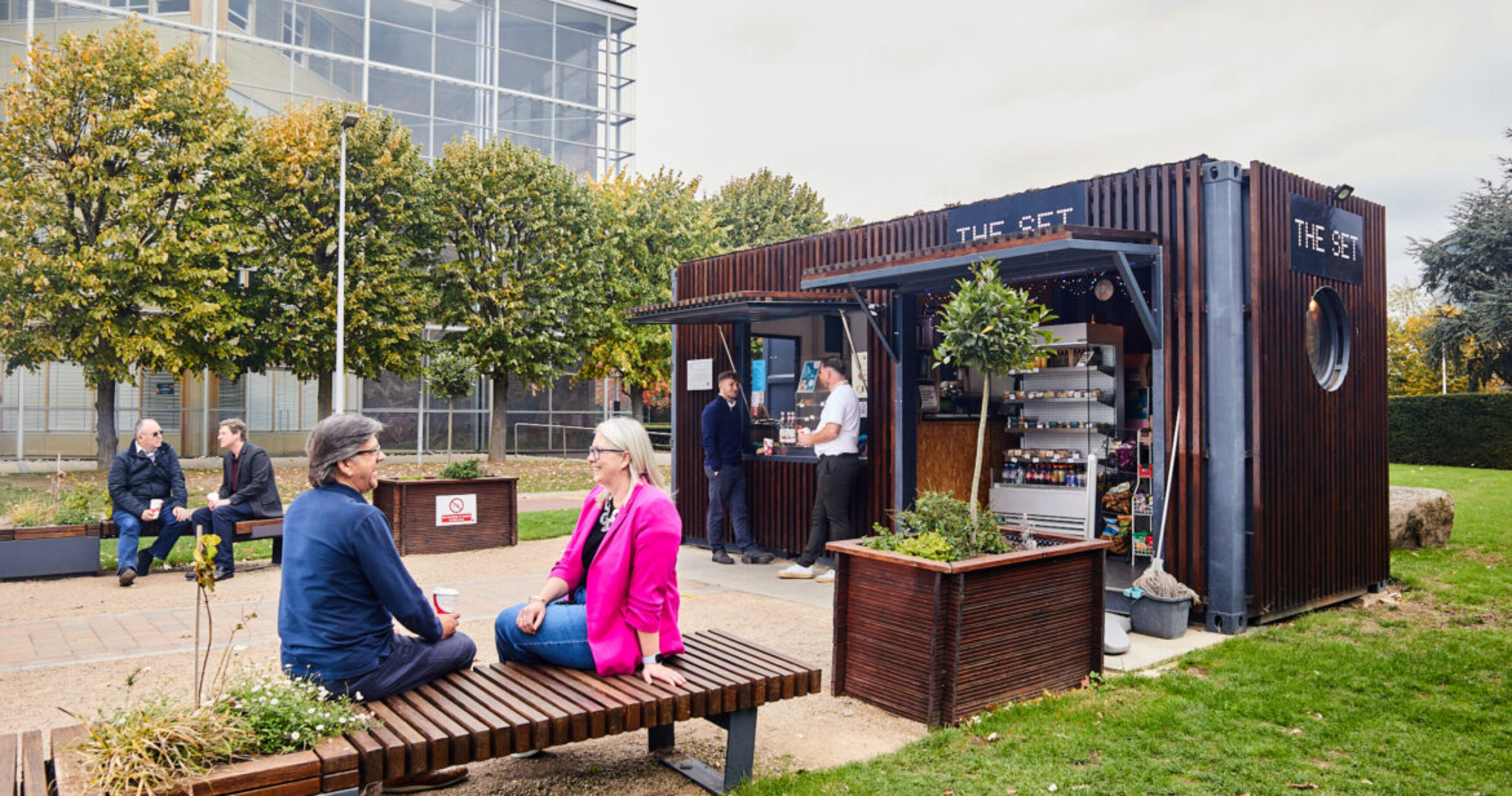
In logistics and business parks, where the scope permits stronger action, interventions frequently focus on job creation, training schemes and fostering social cohesion. Thanks to more abundant green space, these properties increasingly feature biodiversity-led projects such as habitat restoration, community gardens, event spaces, street furniture and enhanced green infrastructure.
High-profile examples are also emerging in central London. At Canary Wharf, the newly unveiled Eden Dock offers a striking waterfront nature space, complete with aquatic islands, marine habitats, art installations and public access to water-based activities. Similarly, at Canada Water, a vivid red boardwalk weaves through urban wetlands, functioning as both public art and vital infrastructure — connecting people to nature while offering views across the 53-acre site. These features directly enhance placemaking and contribute to the desirability of the location.
To further support the adoption of best practices, the Social Value Portal has published a detailed report showcasing practical tools, strategic guidance and success stories. Standardised measurement and reporting frameworks are also gaining traction, enabling companies to embed social value performance into their operations, and benchmark their efforts against others.
Investor appetite is growing for measurable social impact, creating another powerful incentive. The introduction of metrics such as the Real Estate Social Value Index (RESVI) is helping to formalise this space. Many investors and developers are also exploring alternatives like Social Return on Investment (SROI), Cost-Benefit Analysis (CBA), and — where applicable — the European Sustainability Reporting Standards (ESRS). But we also recognise that these frameworks and instruments are all still being developed to accurately reflect the actual impact of social value on the ground, which is where MAPP thrive.

As the real estate sector evolves, sustainability and responsible land use are becoming central to long-term strategy. Social value and the prioritisation of people and communities, is emerging as a key determinant of asset performance. Encouragingly, modest yet well-targeted investments often yield outsized returns — delivering real value both financially and socially.